We are now rapidly approaching the midpoint of 2021 and with that I have compiled my list of the five best books I have read so far.
5.
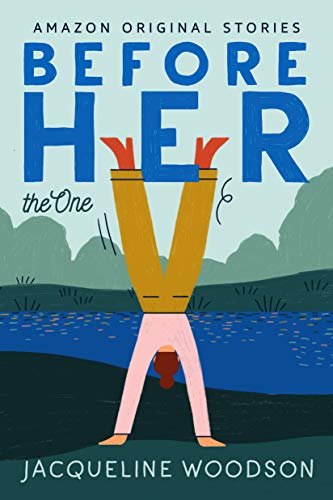
A good memoir is like a leisurely conversation with a spellbinding friend. A good short memoir is like a too brief catch up with the same spellbinding friend. Jacqueline Woodson has the ability to make the mundane come alive. In this short essay, she writes about her single days in New York before she met her partner. I loved every minute of it.
4.
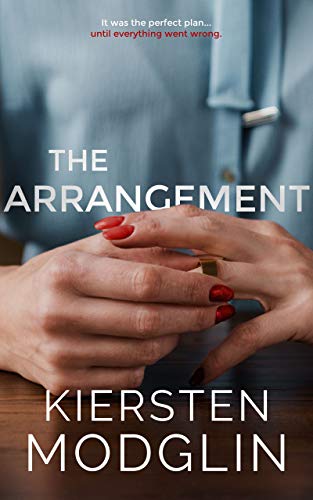
If you read this blog regularly, you know that suspense is my jam. Finding a new author is cause for celebration. I was immediately drawn into this story and couldn’t get up until I found out how Ainsley and Peter were going to get out of their fine mess. What Kiersten Modglin lacks in style, she makes up for in twists.
3.
This memoir reads like a dark Nora Ephron movie. Christie is in a bad head space when she joins a therapy group. As she is forced to share her secrets with strangers, her life and outlook begin to improve. I have my doubts about the overly optimistic trajectory, but experiencing her transition is riveting.
2.
The subject of domestic violence between women is largely taboo. Carmen Maria Machado does something remarkable with the topic, showing the complex emotions that go into surviving the experience. She is a gifted writer telling uncomfortable truths.
1.
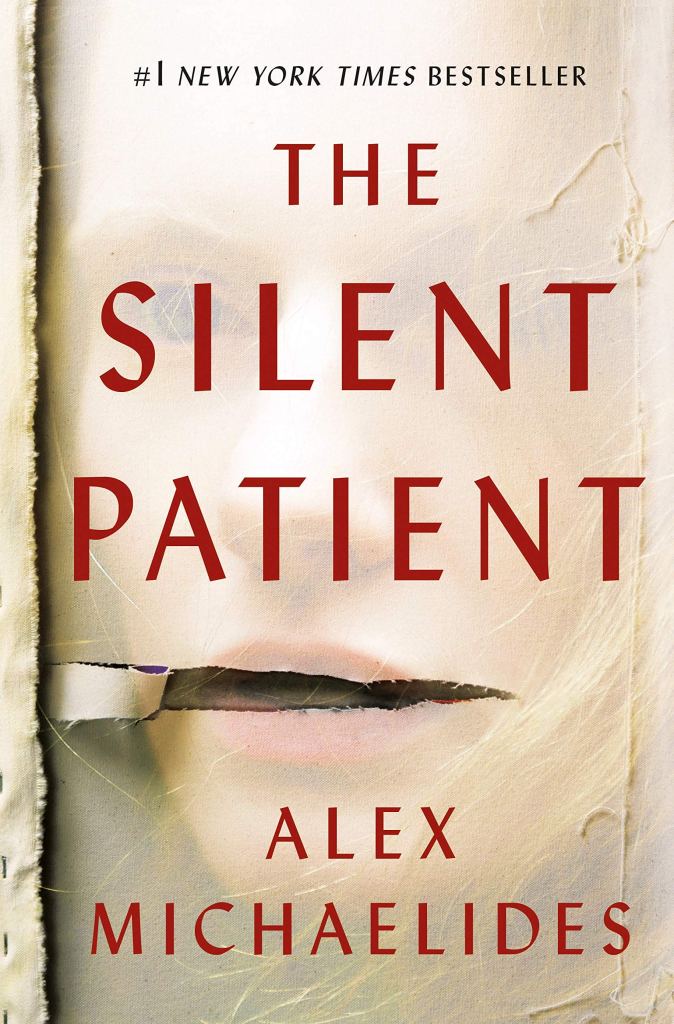
There are better written books on this list, but this gets the top slot because no other book this year has riveted me quite like this one. Theo Faber is a psychologist who takes a job at a London psychiatric hospital. His patient is a mute woman convicted of murdering her husband. The author takes what could be a painfully boring premise and executes a gripping page-turner. I love losing a few days to a good story.
When creating a mystery, you need a compelling premise, five or six plausible culprits, and a few twists along the way. The basic elements of the genre haven’t changed much since the first detective story was published in 1841.
When it comes to secondary elements, the recipe can be tweaked a bit. It used to be that a first-person narrator could not be revealed at the end to be the killer, until the introduction of the unreliable narrator changed all that. It’s now quite common to discover that the character curating the story has left out some significant details, including their complicity in the crime. (It is still the case that an unreliable narrator shouldn’t be the detective or amateur sleuth, but that may change, too. A clever author can pull off plenty.)
Another rule that has shifted is about the most likely suspect. In the course of the plot unfolding, a group of suspects are introduced, often with degrees of plausibility that they are the killer. It used to be that the most likely suspect was a throwaway role, introduced early with the readers’ understanding that this would never be the killer. Readers want to be surprised, after all, and the culprit can’t be too obvious.
Recently, though, this rule is changing a bit. I have yet to read a book where the most likely suspect is the killer, but I have read at least three in which the duration of the story makes it look as though one character is guilty, only to pull off a surprise. Here are three examples.
1.
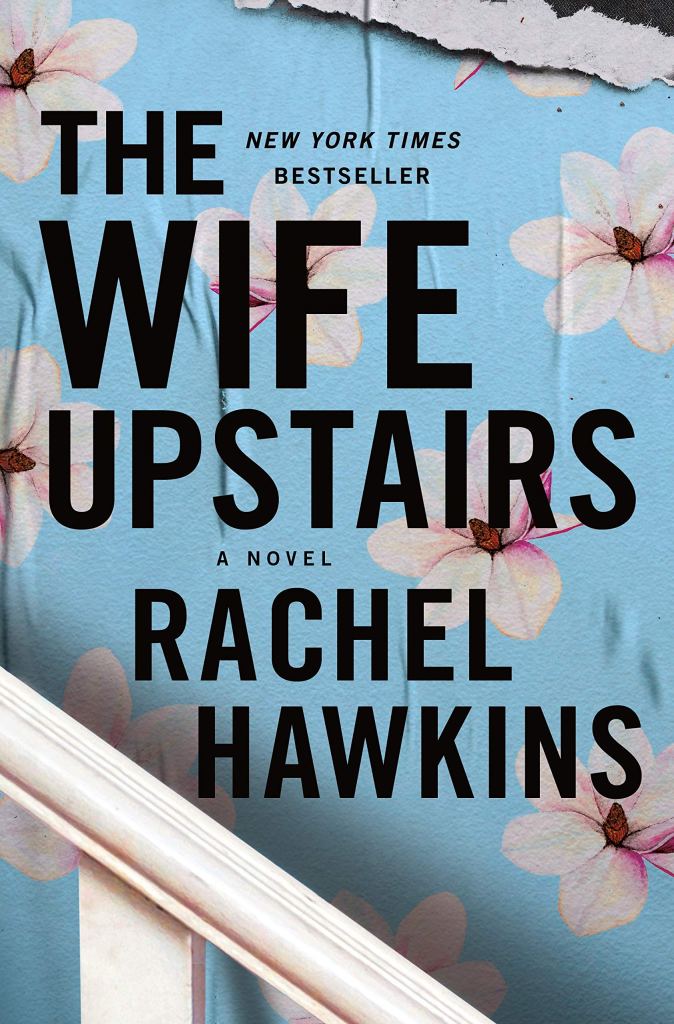
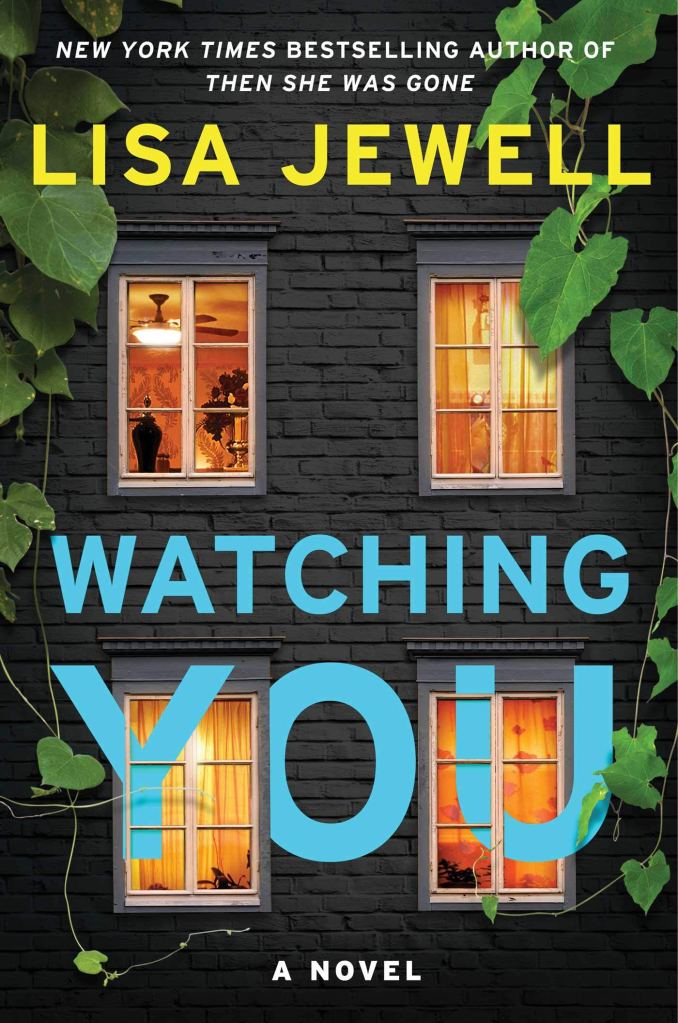
Jane Bell takes a job as a dog walker at a posh housing estate outside Birmingham. She quickly falls for Eddie Rochester, a widower whose wife died in a boating accident with another neighbor. The reader knows the truth: Eddie’s wife is still alive and locked in a panic room. For most of the book, the tension revolves around Jane not knowing that her fiance is a killer. Then – surprise – it turns out Eddie didn’t do it.
2.
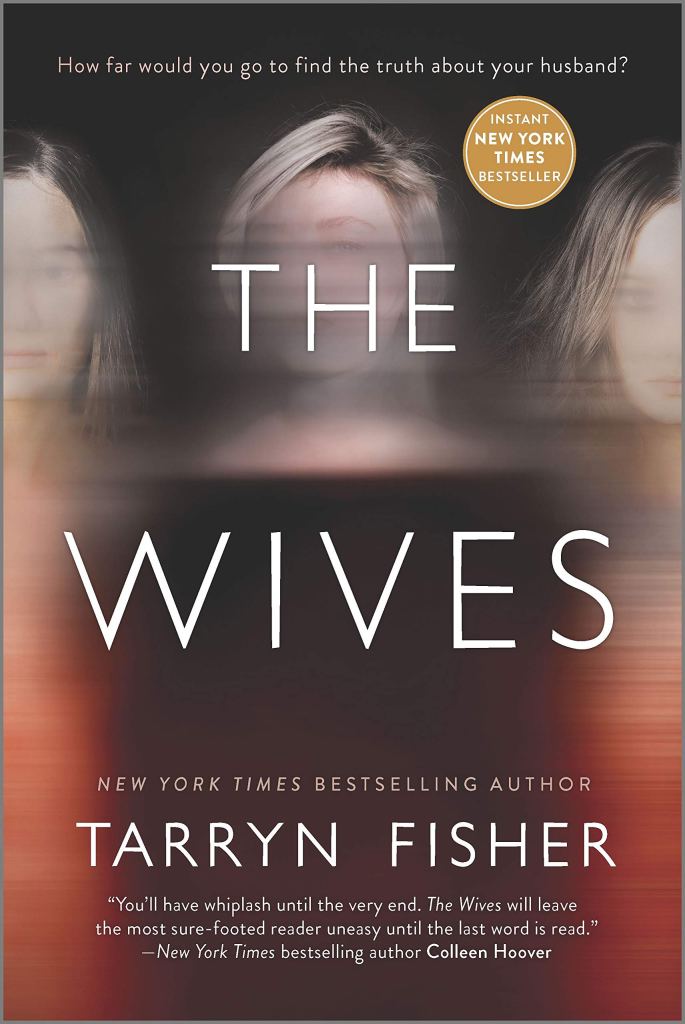
The narrator of this novel calls herself Thursday. It is both her name and her schedule: the fifth day of the week is the only time she gets to see Seth, her husband. He divides his time between three sister wives, an arrangement that reflects his religious upbringing. There are hints that he is abusing one of the wives, Hannah. There is no murder in this story, but Seth is the clear villain, stringing these women along for his own purposes. Then – surprise – nothing is what it appears to be. Seth is not such a bad guy after all.
3.
Joey is a newlywed living with her husband, brother, and sister-in-law in a painted row house in Bristol. Joey is infatuated with her neighbor, a local superintendent named Tom. Tom’s wife, Nicola, is murdered and he is the most likely suspect. Up until the end he seems to have done it. But then, of course, he didn’t.
The husbands fare well in these books. It’s a little difficult to tell who they really are, through, because the majority of the characterization casts them in a suspicious light. In the end, the most likely suspect remains a throwaway role simply because there is no time to get to know him.
In a standard murder mystery, an inciting incident – an unnatural death -happens early on. The detective – amateur or professional – is introduced to investigate the crime, usually in the form of meeting potential culprits and trying to discern their means and motive. There is usually some escalating dramatic tension as the detective pursues the criminal and a cool down after the case is settled.
Domestic suspense has a slightly different formula. In place of the inciting incident, the reader is introduced instead to a central dilemma from which dramatic tension unfolds. The mystery is less about who is guilty of a crime and more about how the conflict will escalate and ultimately resolve.
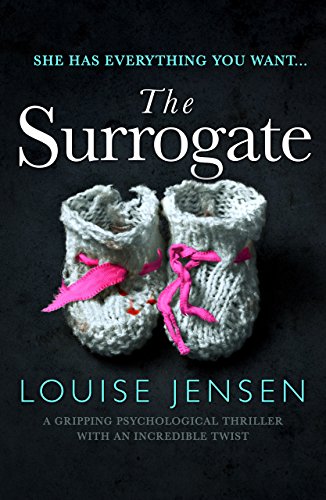
In Louise Jensen’s The Surrogate, a charity worker in an English town, Kat, and her husband, Nick, are at a crossroads. They have tried twice to adopt internationally when Kat runs into a high school friend, Lisa, who tells her she has been a gestational surrogate in the past and is open to doing it again.
The reader is immediately suspicious of Lisa, who makes cryptic comments like, “I think everyone gets what they deserve in life.” There are flashbacks to their high school years in which there appears to be tension between them. And there is a strong hint that tragedy befell a mutual aquaintence, Jake.
Because the reader suspects Lisa, the mystery becomes about how she is trying to deceive her friend. It’s possible that she has designs on Kat’s life: she wants to have Nick’s baby and take over her friend’s more desirable life. It’s also hinted that she might not be pregnant. And there is a suggestion that Nick may be gaslighting his wife, although the reason isn’t clear. Clare, a neighbor, seems cozy with Nick. Or is Kat paranoid and seeing things? Finally there are the high school flashbacks with Jake. What does this have to do with it?
Instead of having four or five suspects at midpoint, we have four or five possible realities. A savvy reader knows that most likely none of them will be the ultimate answer. This is one way that domestic suspense differs from mysteries. While mystery readers rarely appreciate a late-arriving suspect, domestic suspense often hinges on a late reveal of an additional scenario that the reader hasn’t yet thought of.
Louise Jensen pulls it off, with a final resolution that varies a bit from the expected outcomes. Lisa is pregnant, Kat isn’t mentally ill, and Nick isn’t quite as bad as he seems. And, yet, the final act has consequences for all of them. And, of course, Jake has something to do with it.
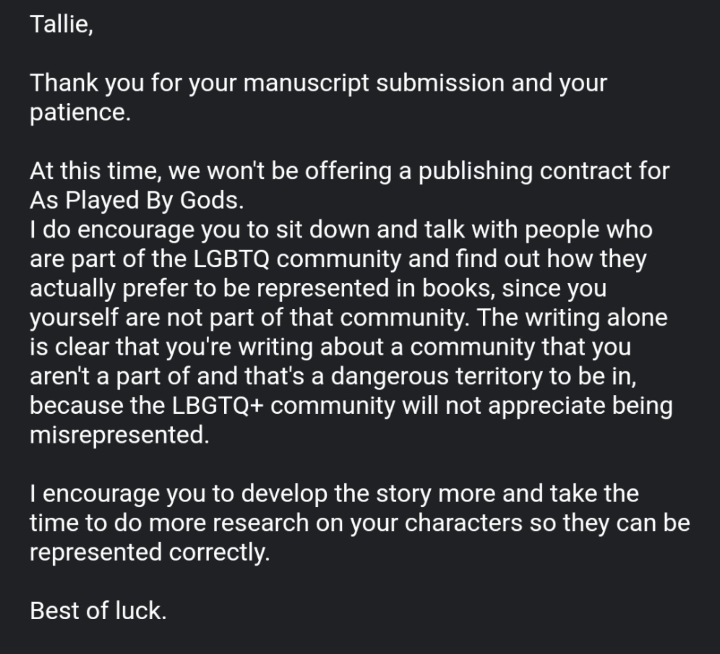
Recently a Twitter war erupted over the following rejection letter, which was sent to an author named Tallie Rose from a small publisher.
The letter is remarkable for two reasons. First, based on a cold reading of a manuscript, the editor assumed that the author had no personal experience with the topics she was writing about. The book’s perceived values were abhorrent to her and she assumed that no LGBTQ person could share them.
Second, the editor was flat wrong in her assumption. The bisexual author was offended that her writing was judged as inauthentic. After all, doesn’t any writing by an LGBTQ author represent some aspect of the community? The editor had foolishly stepped into a hornet’s nest about what an authentic voice is.
This debacle does raise a question: how much can we tell about a writer from her product? After reading Everything That Rises Must Converge by Flannery O’Connor, I assumed she shared the more progressive values of Julian, the young man who takes his racist mother on a desegregated bus. Apparently that was not the case – recently discovered letters suggest she may have been more sympathetic to the Old South. After reading Christopher by Allison Burnett, I was so transported to early ’80s New York that I assumed the author was a gay man. After meeting him at a book signing, I realized he was married to a woman. I was grossed out by the sex scenes in Ruuman Alam’s Leave The World Behind until I realized he is gay and the scenes may have been a critique of conventional marriage.
Writers attempt to capture something about life that they believe to be true. They may or may not agree with it. They may or may not have direct experience with it. The reader may reflexively assume that the writer shares their subjective judgement of the story. Sometimes that is not the case. Reading is a highly personal experience. Reactions to books often reveal more about the reader than the author.
When it comes to journal excerpts in contemporary suspense, readers should be skeptical. Like the now expected unreliable narrator, journal entries are a device for the author to mess with perceived reality.
The first time I encountered this was not in suspense but in literary fiction. In 2010, Louise Erdrich published Shadow Tag, a compelling story of an abusive marriage. After Irene discovers that her husband, Gil, is reading her journal, she begins deliberately manipulating her entries, while saving the truth for another diary, which she keeps locked in a safe deposit box.
The two journals alternate with a third person narration. The effect on the reader is disarming, while the brain scrambles to make sense of what is real.
A few years later, Gillian Flynn used a similar trick in Gone Girl. Nick Dunne wakes up on his fifth anniversary to discover that his wife, Amy, has been kidnapped. Alternating with his narration are selections from Amy’s diary, detailing their courtship in New York, wedding, and a turn in fortune after Nick loses his job and they are forced to move back to Nick’s hometown in the Midwest. The escalating tension in the entries lead the police to suspect Nick was an abusive husband.
But then — twist! — it turns out Amy staged her own disappearance to frame Nick. Her journals are partly fictional and designed to guide police to conclude that he is the culprit.
Because of the popularity of Gone Girl, knockoffs were inevitable. One of the better imitators is Alice Feeney’s Sometimes I Lie.
Knowing that readers will be skeptical of narrators in this genre, the book’s opening lines tell us that the protagonist, Amber, is an occasional liar. So straight out of the gate, defensive reading is required.
Amber is presently in a coma after a car accident. In flashbacks, we see the events that lead to the present. The police also find Amber’s childhood diary in which she talks about being adopted by the family of a school friend named Taylor.
Any savvy reader knows to be skeptical of the journals. After all, we know Amber is dishonest. In a clever twist, it turns out the police have made an error. The diaries were written not by Amber but about her. Taylor was her childhood nickname. Because of their mistake, everything the reader thought they knew about Amber is true of a supporting character instead.
The most recent use of purloined journals is Carola Lovering’s Too Good To Be True.
Skye is a lonely book editor in New York when she meets Burke at a Montauk hotel. They quickly fall in love and get engaged. The reader knows something that Skye does not: Burke is broke and married, trying to scam money out of Skye’s wealthy family to help his first family. We learn of this nefarious plan in journal excerpts that Burke is writing at the suggestion of his marriage counselor. Once he and Skye wed, Burke will steal two million dollars and run off with Heather, his true love and mother of his three children.
It is hard to read about what Burke and Heather are doing to their unsuspecting victim, even as a third narrative spells out a legitimate vendetta Heather has against Skye’s mother.
Just after their Italian honeymoon, Skye is in for a shock when she discovers Burke’s journals. And — twist! — the reader is too when it is revealed Burke didn’t write the entries. Heather did. And — twist! — the real Burke has fallen in love with Skye. Her narration about him is accurate. The journals are fiction written by a spurned spouse.
Because of the careful sleight of hand by the author, Burke’s love for Skye is a surprise. I was not wild about Skye’s quick forgiveness of him. Their relationship was still started in deceit. But the plotting was clever.
My general reading rule is that when I see the same trick done in five different books, it’s becoming a cliche. Future authors are going to have to come up with another variation on the unreliability twist. But what will it be?
After the past year, the opioid crisis has fallen away from headlines. Alas, it is still very real, killing over 80,000 people in 2020. Since 1999, over 800,000 Americans have died from drug overdoses, 70% of them related to opioids.
As Beth Macy details in Dopesick, poppy-derived opiates are nothing new. Morphine and heroin were used to treat wounded soldiers in the Civil War, and heroin was available for purchase in many drugstores at the turn of the Twentieth century. The term junkie was coined for addicts who salvaged scrap metal from junkyards to support their habits.
Opioid is a more recent term referring the synthetic variants of heroin. They notoriously reentered the American landscape in the late nineties, as pharma sales reps eagerly sold a new painkiller, OxyContin, to doctors. The Appalachian Bible Belt was particularly hard hit, as workers injured from blue collar jobs sought relief from a prescription pad. The sales reps were dead wrong in their estimation that OxyContin was harmless. Within weeks of using doctor-prescribed pills, many patients were hopelessly addicted, seeking heroin on the black market when their physicians cut them off.
Dopesick details the personal scourge of opioids. Activist doctors try to educate the public, grieving parents bury teenagers, and addicts turn to sex work to fund their habits. An economically depressed region creates a new job market for dealers driving to and from Baltimore and DC.
There isn’t much hope in the story. For every five people seeking rehab, there is one available bed. Many can’t pay the deductible after hospital stays. Entire families bear the brunt of addiction.
The people featured – doctors, activist nuns, mothers of dead children – are vividly drawn. There is one family where ten members are addicts. Many people end up in prison.
Dopesick is a reminder of a silent scourge that has been with us for a long time. Its message is not promising.
Given the untenable number of books I own, I have instituted a few reading rules. The first I call the one and done. If you’ve ever done any online dating, you have probably heard the term: it refers to a common occurrence when there is not enough chemistry to merit seeing each other again. In other words, no second date. It’s all very practical: why waste time when the fundamentals aren’t there? I take the same approach to authors. For the most part, I rarely read the same author twice.
There are some exceptions. There are a handful of authors – Harlan Coben, Anne Tyler, Anne Lamott, Armistead Maupin – I have read nearly a dozen times. I click with them and often can’t resist the next title. There are still others – Jodi Picoult, Ann Patchett, Glennon Doyle – whom I have read two or three times.
Overall, though, I read an author once and move on. Why? With so many books to choose from, I like to cover as much ground as possible. There are so many writers working hard and hoping to find readers that I feel a community obligation to assist. Publishing is becoming increasingly brand-driven and I want to resist that.
Every once in a while, I break my own rules. Call it a cheat read. Sometimes I find a new writer I like enough to read twice. Such is the case with this week’s author, Jessica Barry.
Last summer, a boring Saturday was transformed when I discovered her book Don’t Turn Around.
In it, Cait picks up Rebecca under cover of night and drives her from Lubbock to New Mexico. In alternating chapters, we learn about the two women. Rebecca is married to a local politician who became an alt-right hero after he spoke out against a #metoo outing. Cait wrote a blog that went viral about her sexual assault.
As the woman drive together, we learn they are being tailed. Someone doesn’t want them to get to New Mexico.
I was instantly drawn into the plot, which is well-crafted and ripped from the headlines. As the tension of the drive builds, the backstories of Cait and Rebecca snap into place.
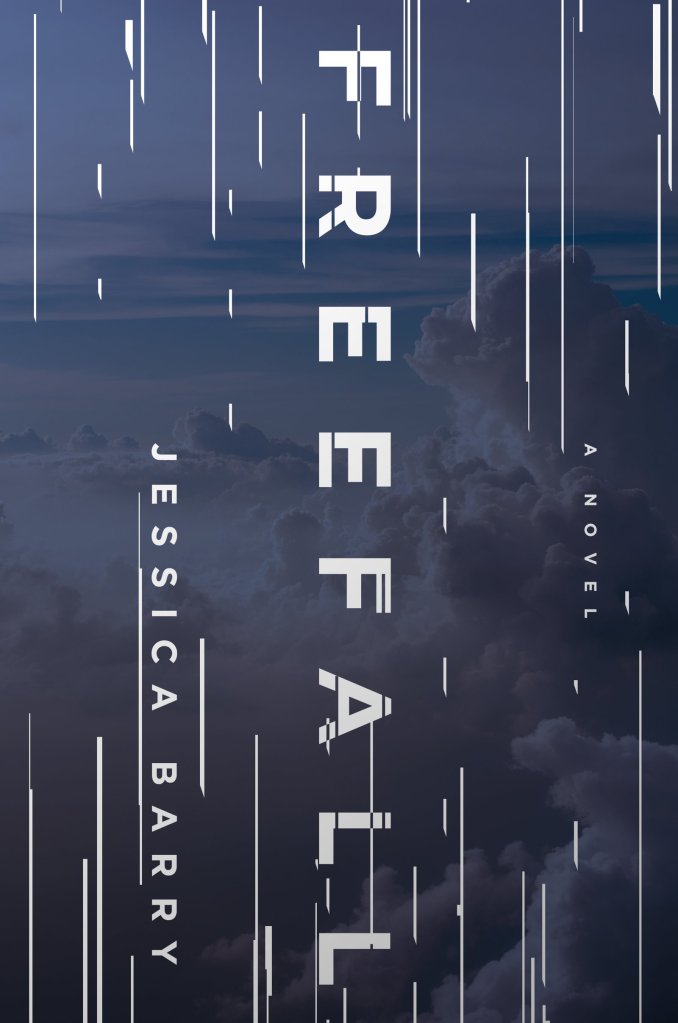
With an author this skilled, I couldn’t resist reading her again. Her first novel, Freefall, establishes what I now think of as Barry’s type scenarios. Like Don’t Turn Around, this one focuses on two women, and switches back and forth from their perspectives. She skillfully builds tension until it is impossible to look away.
Maggie is a widow living in Owl’s Creek, Maine. She is estranged from her adult daughter, Allison, when she learns that the private plane she was on has crashed in the Rocky Mountains. Unbeknownst to her, Allison has survived the crash and is struggling to find help. She is also being pursued by someone who wants to kill her.
The narrative shifts back and forth between Allison’s harrowing circumstances and Maggie’s investigation into her daughter’s secret life.
Like Don’t Turn Around, Freefall is a tensely plotted story with just enough twists. I genuinely rooted for Allison to triumph over her circumstances and be reunited with Maggie.
Time will tell if Jessica Barry maintains my interest. But for now I will be watching for her next book.
My introduction to adultery was a very public affair. In the ’80s, rumors swirled that the fairy tale marriage of Prince Charles and Princess Diana was on the rocks. There were allegations, a separation, and finally an interview in 1995 watched by millions. “I don’t want a divorce,” Diana said. “(But) there are three of us in the marriage. It’s a bit crowded.”
A few years later, we were rocked by another scandal, this time on the other side of the pond. The reelected forty-second president stood in front of the cameras and addressed the nation. “Indeed I did have a relationship with Miss Lewinsky that was not appropriate. In fact, it was wrong.” Bill and Hillary Clinton were on the verge of divorce with the country watching.
There was a clear moral tenor to all of this: adultery was wrong, difficult to forgive, and hurtful to spouses and children. And, yet, curiously, the fiction produced during that time had a different set of values. Adultery was glamorized as a romantic ideal in two best-selling love stories.
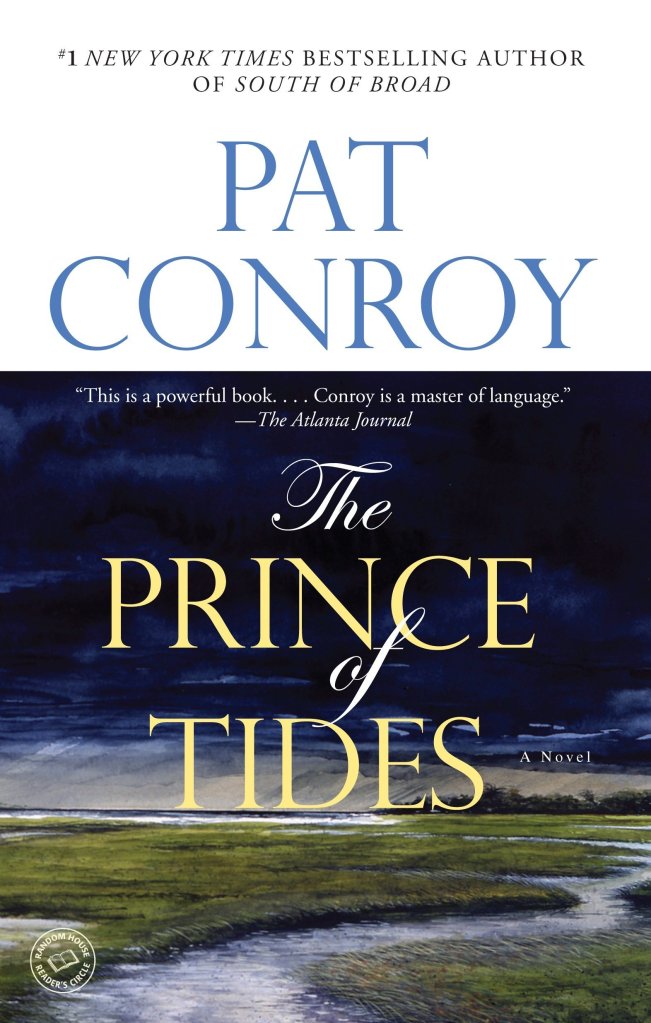
In The Prince of Tides, Tom Wingo is a South Carolina teacher who travels to New York after his sister attempts suicide. There he begins a relationship with Susan Lowenstein, his sister’s psychiatrist. As they explore the siblings’ troubled childhood, Tom and Dr. Lowenstein fall in love.
In both the book and its Oscar-nominated adaptation, Dr. Lowenstein is the true hero of the story. She helps Tom unlock his emotional trauma and lovingly supports him. There is little attention paid to the professional lines she has crossed or to the harm being done to Tom’s three daughters. Compared to the excoriated Camilla Parker-Bowles, Susan emerges unscathed.
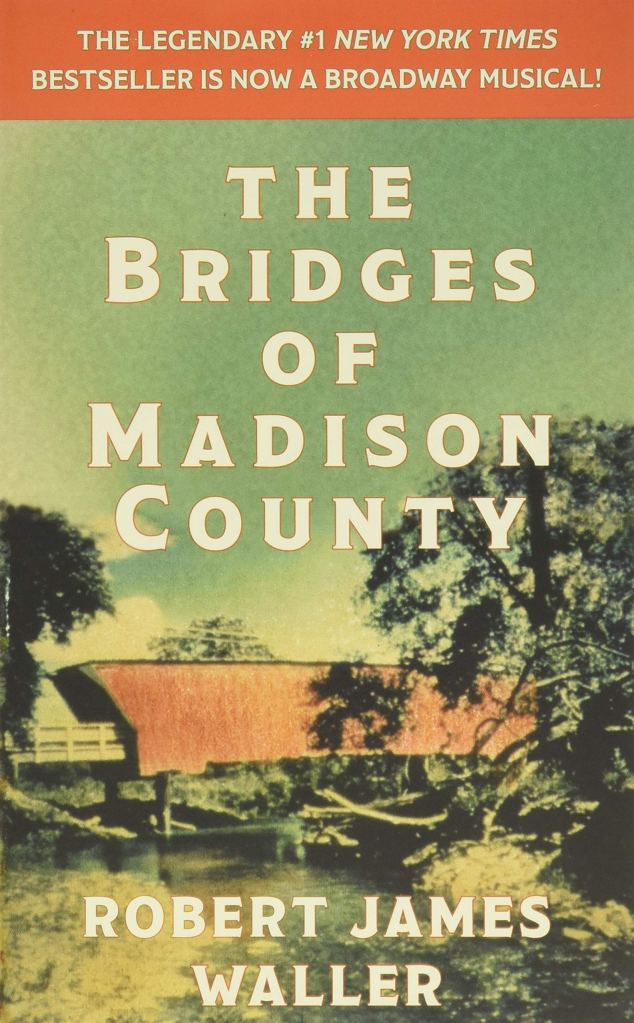
At around the time of Charles and Diana’s very public separation, a short novel was taking the publishing industry by storm. It was the story of a lonely Iowa housewife who encounters a man named Robert Kinkaid, who is in the area to photograph the famous covered bridges. While her family is away at the state fair, Francesca and Robert engage in a once-in-a-lifetime affair.
Like Dr. Lowenstein, Robert is a hero. He not only inflames Francesca’s passion but he gives her a way out of her unhappy life. The tragedy of the story is her inability to leave with him. When Kinkaid later dies, Francesca tells her children not to make the same mistake she did.
So why was adultery so romanticised in popular fiction, especially at a time when public examples told a different story? It’s possible that the authors, both men, were reflecting on the previous generation, when marriage was an obligation. Adultery was seen as a pleasant escape from commitment.
It was also an era when marriage was more commonplace. Francesca was a war bride who married a man she hardly knew. Tom Wingo was a repressed child rape victim. The suggestion here is that their marriages were artificial and their affairs were the real deal.
As we move into contemporary fiction, the perspective on adultery has changed. Cheating is no longer seen as part of the emotional catharsis of the protagonist. On the contrary, marriage is now viewed as fulfilling and adultery as immature and rightly doomed.
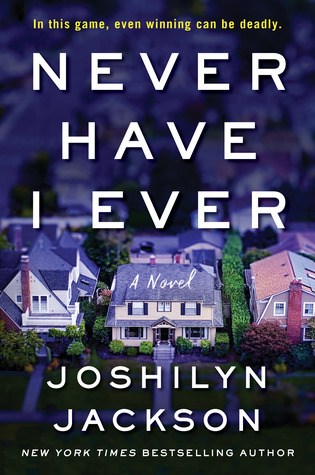
In Never Have I Ever, Amy reconnects with her high school crush Tig. Their brief romance was interrupted when they were in a car crash that killed a local woman. In the present, Amy is happily married with a baby. The temptation is there, though, and she flirts with the idea of crossing a line. Ultimately, though, Amy pulls back before anything gets out of hand.
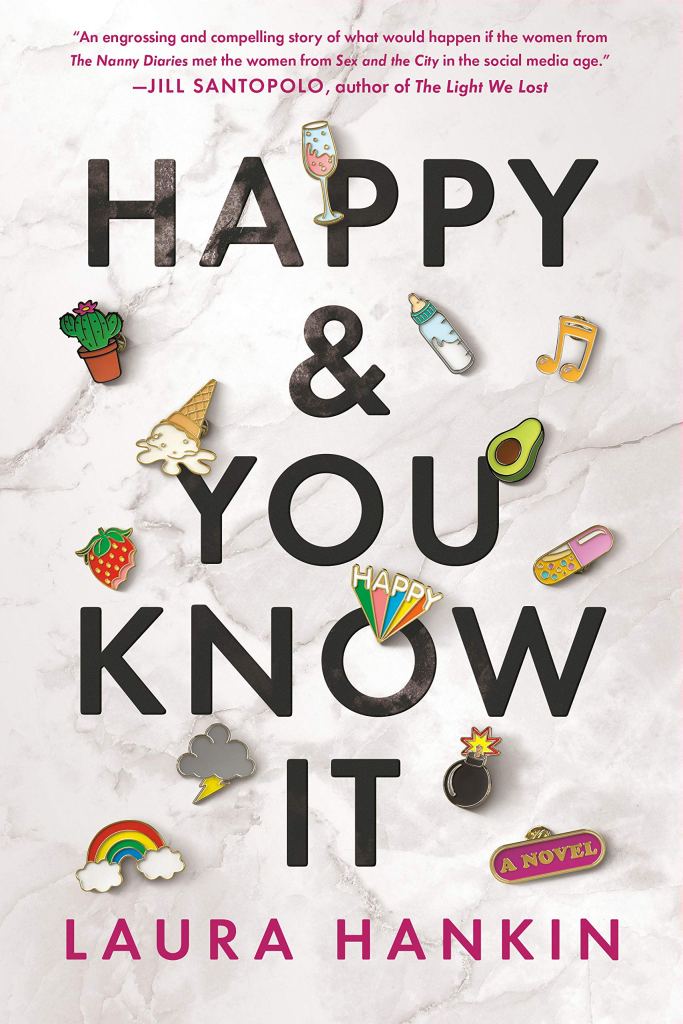
In Happy and You Know It, Whitney is an influencer who falls for a friend’s husband. Their tryst is undeniably hot, but is ruined one day when Whitney’s babysitter cancels at the last minute. When Whitney shows up to a hotel room with her baby in a stroller, Christopher is over it. He has no desire to be a part of Whitney’s family.
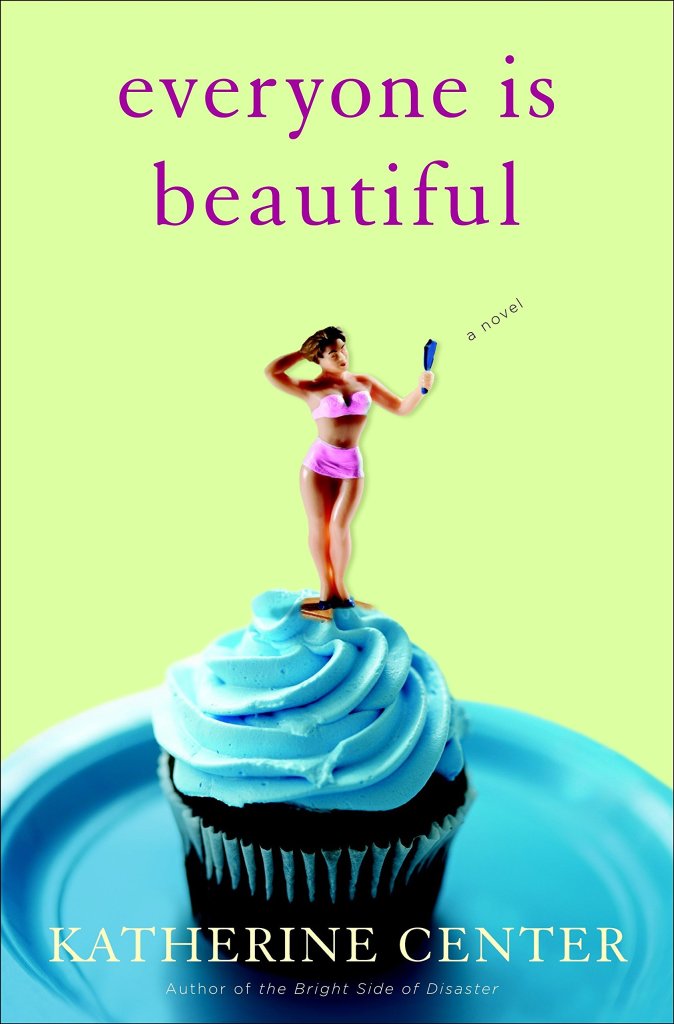
Everyone is Beautiful is another domestic novel that ultimately romanticises marriage over adultery. Lanie is the harried mother of three young boys. She and her husband relocate to Boston so he can pursue his music. While reconnecting with her photography, Lanie revels in being her teacher’s crush. She does not share Nelson’s feelings, but she enjoys the attention. When Nelson kisses her and declares his love, Lanie must grapple with her guilt. Curiously, though, she is never once tempted to take him up on it. Their brief encounter just reinforces how much more chemistry she has with her husband. Their intimacy and familiarity are the real turn on.
Clearly something has changed in fiction. Has marriage actually replaced the affair in terms of social desirability? The real achievement seems to be a marriage that is better than an affair. This could reflect a growing cultural maturity. With more people in therapy plumbing their issues, intimacy is getting better. Once an escape, affairs are becoming passe.
Or maybe this publishing trend reflects something more sinister. The need to keep up appearances – curating a fictitious domestic narrative – may have seeped into fiction. Everyone now wants to believe something about marriage which isn’t true.
One of the open debates in current reading times – in everything from casual book club conversations to literary agent circles – is how unlikeable a protagonist can be. The old-school rules instruct us that a story centers around a hero who undergoes a journey from innocence to experience. The antagonist is a supporting character, creating barriers and obstacles to the hero. The antagonist may be central to the plot, but the emotional arc isn’t about him.
Contemporary commercial fiction is grappling with the rules. For the most part, they stay the course, finding dozens of creative ways to keep plotting fresh.
Amy Dunne starts off Gone Girl as a supporting character: the missing and presumed dead wife of narrator Nick. It appears that he is guilty of doing something horrible to her. We learn of escalating domestic violence in excerpts from Amy’s journals. And then – spoiler alert – it turns out Amy staged her own kidnapping to frame Nick. She left a mostly fictional diary behind to help the police.
Depending on how you look at it, Gone Girl is either a conventional narrative or a subversion of it. If Nick is the protagonist, he undergoes a journey from the woman he thinks Amy is to who she really is. Amy is the antagonist. Nick is not terribly sympathetic, though, so the rules are still being messed with.
Another way of looking at it is that Amy is the unreliable, and unlikeable, protagonist. Giving Nick the opening narration is a trick to disguise what the story is really about: Amy’s manipulation of him. It has never been written that the character opening the story need be the protagonist.
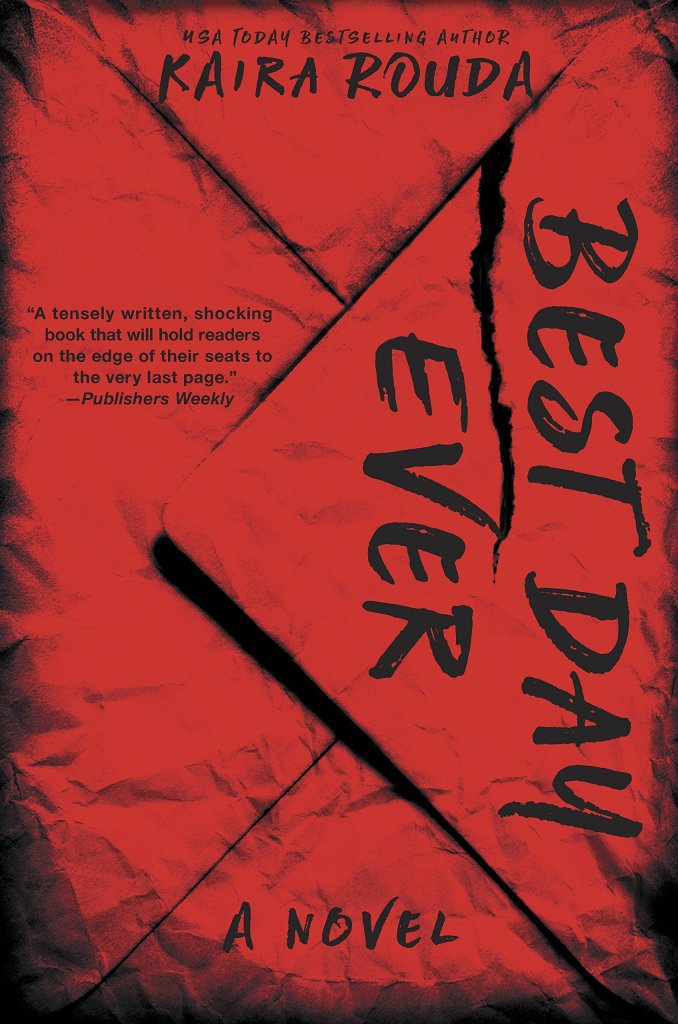
Some authors subvert the rules entirely. Kaira Rouda’s Best Day Ever is one of many Gone Girl knockoffs. The narrator is a sunny guy taking his wife for a weekend to their lake house on Lake Erie. It slowly becomes clear that he is a narcissist and, more alarmingly, a sociopath. His wife is in danger and doesn’t know it.
Here we have a subversion of the standard plot. The protagonist is a monster and the main supporting character is his victim. There is a twist at the end, but not enough to alter the roles in the way Gone Girl does.
Somewhere in the middle of all this is Joshilyn Jackson’s Never Have I Ever. The protagonist, Amy, is a scuba diving instructor living with her modern family in Florida. She has a best friend, an adorable baby, and a husband and teen stepdaughter. In the opening scene, she attends a book club meeting with the local moms. A new neighbor, Roux, cajoles the group into playing a few rounds of a secret-revealing game. Amy is uncomfortable and certain that Roux is baiting her.
Amy has a secret. And as it is revealed, she begins to walk the line between likeable and not. Roux is a good antagonist to balance this out. She is a slightly contrived character who acts as an external conscience for Amy’s guilt, a kind of human telltale heart. In the end, Amy’s remorse keeps her on the hero’s path.
Of the recent trends with books and reading, few charm me more than the idea of going on a blind date with a book. Bookshops and libraries have embraced this idea, setting up hopeful readers with potential matches. All it takes is a willing heart and a short commitment of time.
How does it work? Booksellers and librarians select titles and wrap them like gifts. There is usually some information given about genre, either written on the package or on an attached gift card. You select the book mostly at random: if you don’t care for chick lit or Westerns, you can skip those, so there is some control. But at some point you have to select a package and open it. Then you make the commitment to read it.
I’ve never had the opportunity to do the real blind book date, but I think it can be improvised. So long as you have a heap of unread books, you can do it.
I recently was set up on a first blind date with a book. From my digital files of 445 unread books, I selected the random number of 222. To ensure that I wasn’t tainting the process, I asked an unknowing aquaintence to pick the number.
Scrolling through the list, I discovered this book at 222:
‘This Could Hurt’ by Jillian Medoff.
A topic for another blog is the insane number of unread books that I own. 445 is a lot. But in this case numbers work to my advantage because there was a genuinely random quality to this choice. If I asked all my friends to set me up on a real blind date, I’m not sure the potential pool would be higher than that.
I don’t know why I bought this title. Most likely I read an enthusiastic review on a book blog. It is fiction, which suits me. Its theme of corporate downsizing is relatable. I’m sure it had many glowing blurbs urging me to give it a whirl.
So will this be a love connection or a bust? Find out next week!






 Books Smitten