In a standard murder mystery, an inciting incident – an unnatural death -happens early on. The detective – amateur or professional – is introduced to investigate the crime, usually in the form of meeting potential culprits and trying to discern their means and motive. There is usually some escalating dramatic tension as the detective pursues the criminal and a cool down after the case is settled.
Domestic suspense has a slightly different formula. In place of the inciting incident, the reader is introduced instead to a central dilemma from which dramatic tension unfolds. The mystery is less about who is guilty of a crime and more about how the conflict will escalate and ultimately resolve.
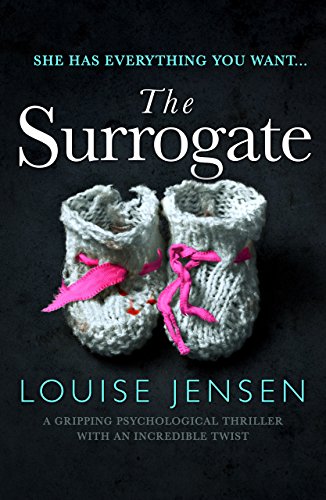
In Louise Jensen’s The Surrogate, a charity worker in an English town, Kat, and her husband, Nick, are at a crossroads. They have tried twice to adopt internationally when Kat runs into a high school friend, Lisa, who tells her she has been a gestational surrogate in the past and is open to doing it again.
The reader is immediately suspicious of Lisa, who makes cryptic comments like, “I think everyone gets what they deserve in life.” There are flashbacks to their high school years in which there appears to be tension between them. And there is a strong hint that tragedy befell a mutual aquaintence, Jake.
Because the reader suspects Lisa, the mystery becomes about how she is trying to deceive her friend. It’s possible that she has designs on Kat’s life: she wants to have Nick’s baby and take over her friend’s more desirable life. It’s also hinted that she might not be pregnant. And there is a suggestion that Nick may be gaslighting his wife, although the reason isn’t clear. Clare, a neighbor, seems cozy with Nick. Or is Kat paranoid and seeing things? Finally there are the high school flashbacks with Jake. What does this have to do with it?
Instead of having four or five suspects at midpoint, we have four or five possible realities. A savvy reader knows that most likely none of them will be the ultimate answer. This is one way that domestic suspense differs from mysteries. While mystery readers rarely appreciate a late-arriving suspect, domestic suspense often hinges on a late reveal of an additional scenario that the reader hasn’t yet thought of.
Louise Jensen pulls it off, with a final resolution that varies a bit from the expected outcomes. Lisa is pregnant, Kat isn’t mentally ill, and Nick isn’t quite as bad as he seems. And, yet, the final act has consequences for all of them. And, of course, Jake has something to do with it.
 Books Smitten