Recently a Twitter war erupted over the following rejection letter, which was sent to an author named Tallie Rose from a small publisher.
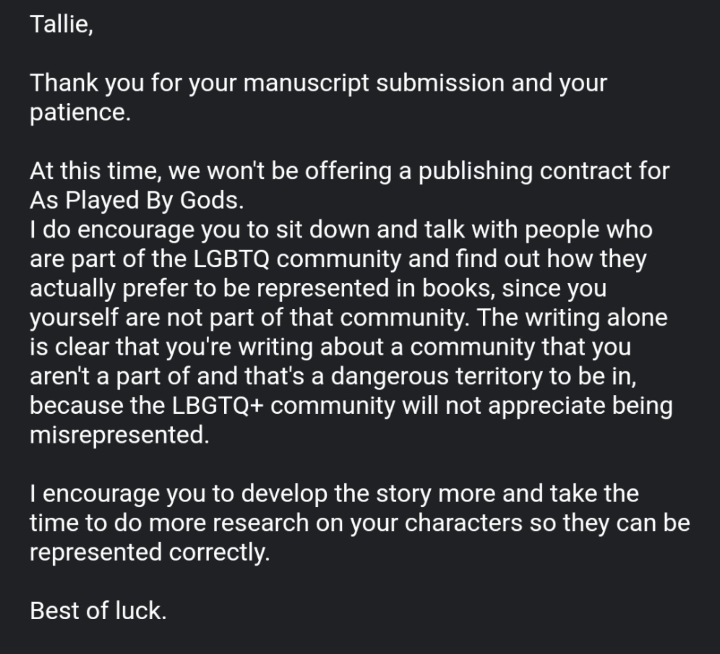
The letter is remarkable for two reasons. First, based on a cold reading of a manuscript, the editor assumed that the author had no personal experience with the topics she was writing about. The book’s perceived values were abhorrent to her and she assumed that no LGBTQ person could share them.
Second, the editor was flat wrong in her assumption. The bisexual author was offended that her writing was judged as inauthentic. After all, doesn’t any writing by an LGBTQ author represent some aspect of the community? The editor had foolishly stepped into a hornet’s nest about what an authentic voice is.
This debacle does raise a question: how much can we tell about a writer from her product? After reading Everything That Rises Must Converge by Flannery O’Connor, I assumed she shared the more progressive values of Julian, the young man who takes his racist mother on a desegregated bus. Apparently that was not the case – recently discovered letters suggest she may have been more sympathetic to the Old South. After reading Christopher by Allison Burnett, I was so transported to early ’80s New York that I assumed the author was a gay man. After meeting him at a book signing, I realized he was married to a woman. I was grossed out by the sex scenes in Ruuman Alam’s Leave The World Behind until I realized he is gay and the scenes may have been a critique of conventional marriage.
Writers attempt to capture something about life that they believe to be true. They may or may not agree with it. They may or may not have direct experience with it. The reader may reflexively assume that the writer shares their subjective judgement of the story. Sometimes that is not the case. Reading is a highly personal experience. Reactions to books often reveal more about the reader than the author.
 Books Smitten